Di Thanksbuyer
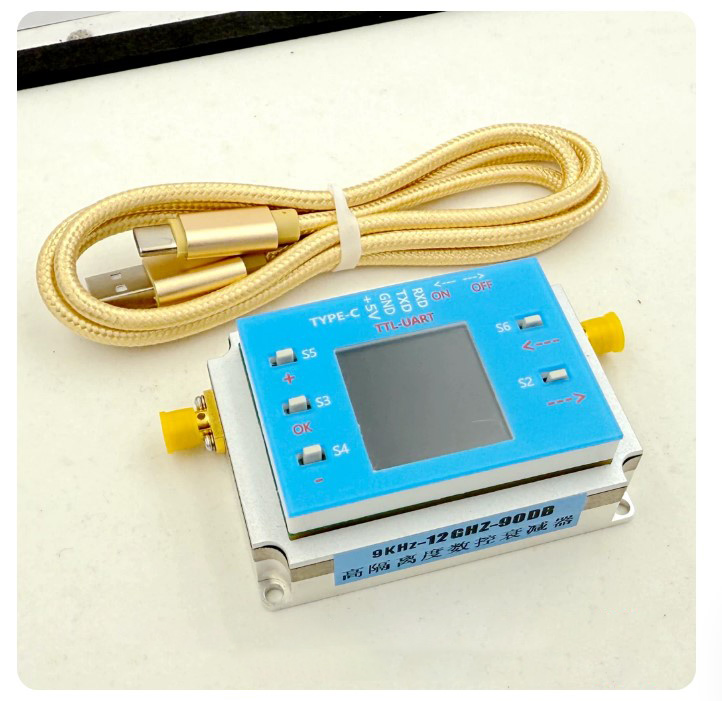
Digital Programmable RF Attenuator 9kHz-3GHz 9kHz-6GHz 9kHz-8GHz 9kHz-12GHz 90dB Attenuation Range 0.25dB Step Signal Testing
$53.52 - $84.62
Imposte incluse.
Spese di spedizione calcolate al check-out.
Prezzo di listino
$53.52
Prezzo di listino
Prezzo scontato
$53.52
Prezzo unitario
per
Impossibile caricare la disponibilità di ritiro
Availability:
2000 disponibile/i
SKU:
106389
Tags:
Collections:

Prezzo di listino
$53.52
Prezzo di listino
Prezzo scontato
$53.52
Available Options:
* 9kHz-3GHz Version
* 9kHz-6GHz Version
* 9kHz-8GHz Version (High Isolation, Recommended for Most Applications)
* 9kHz-12GHz Version (High Isolation)
Description:
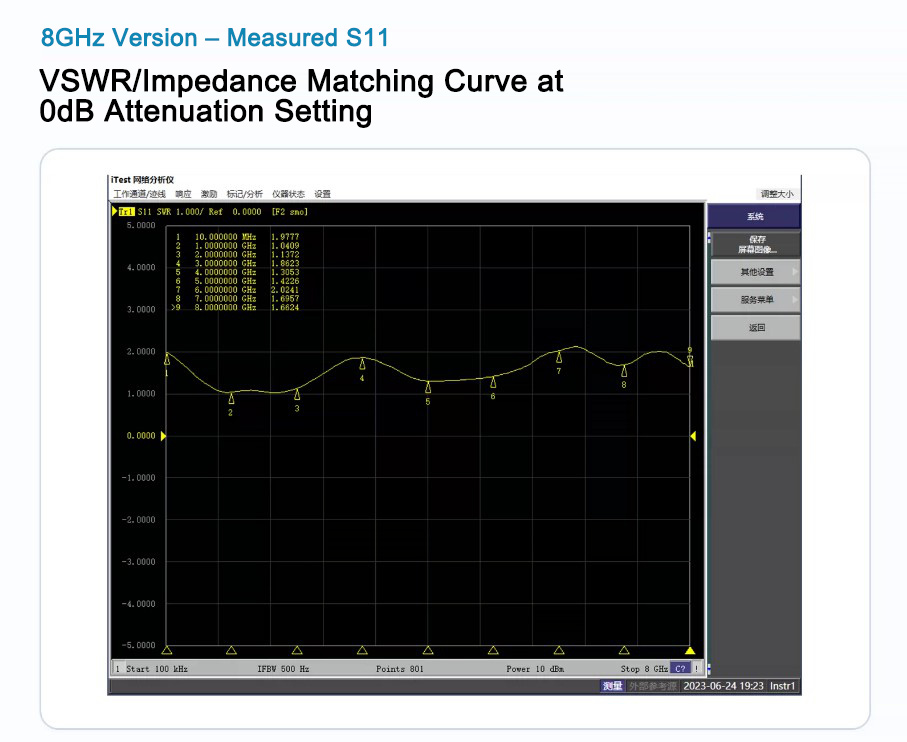
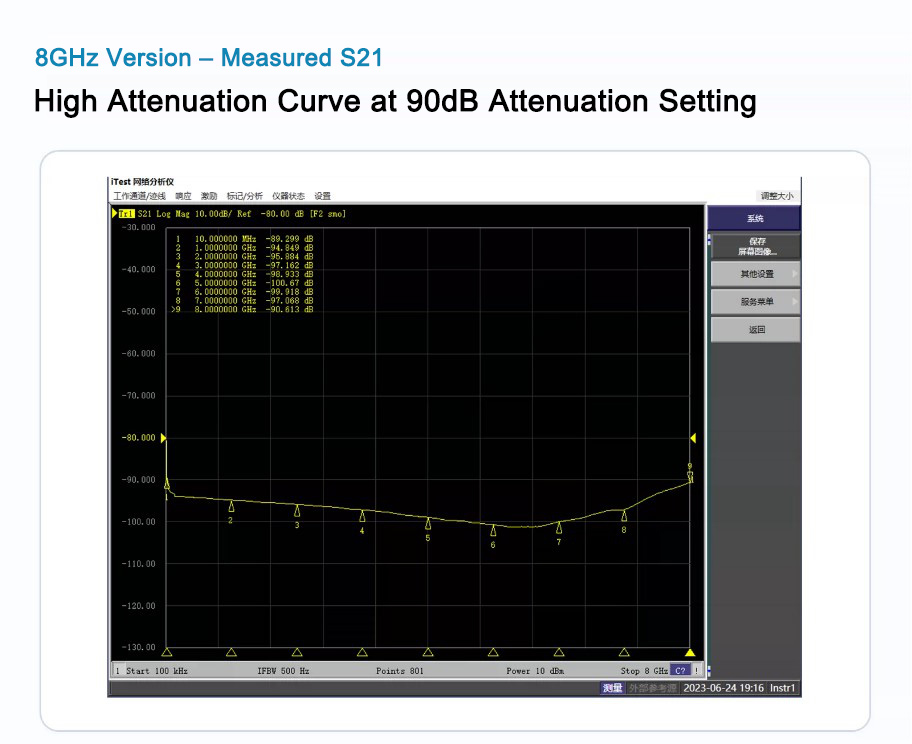
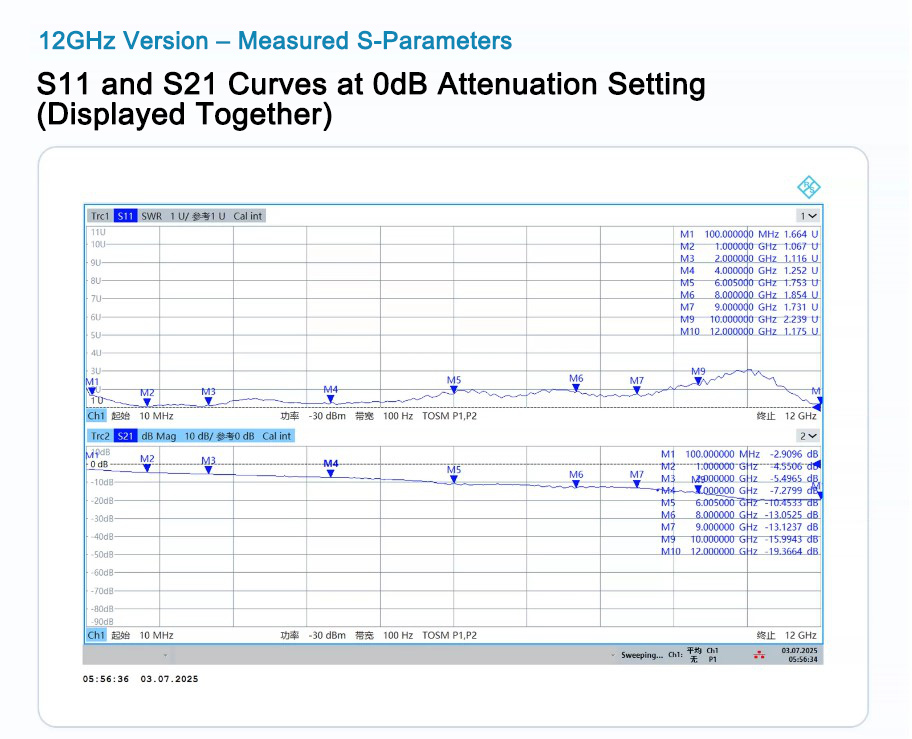
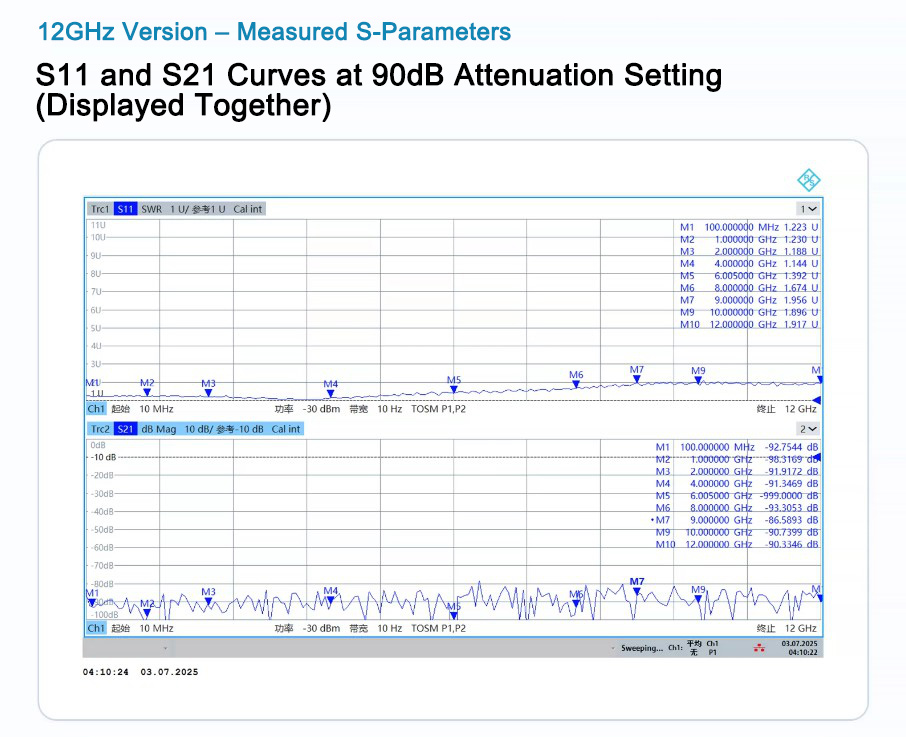
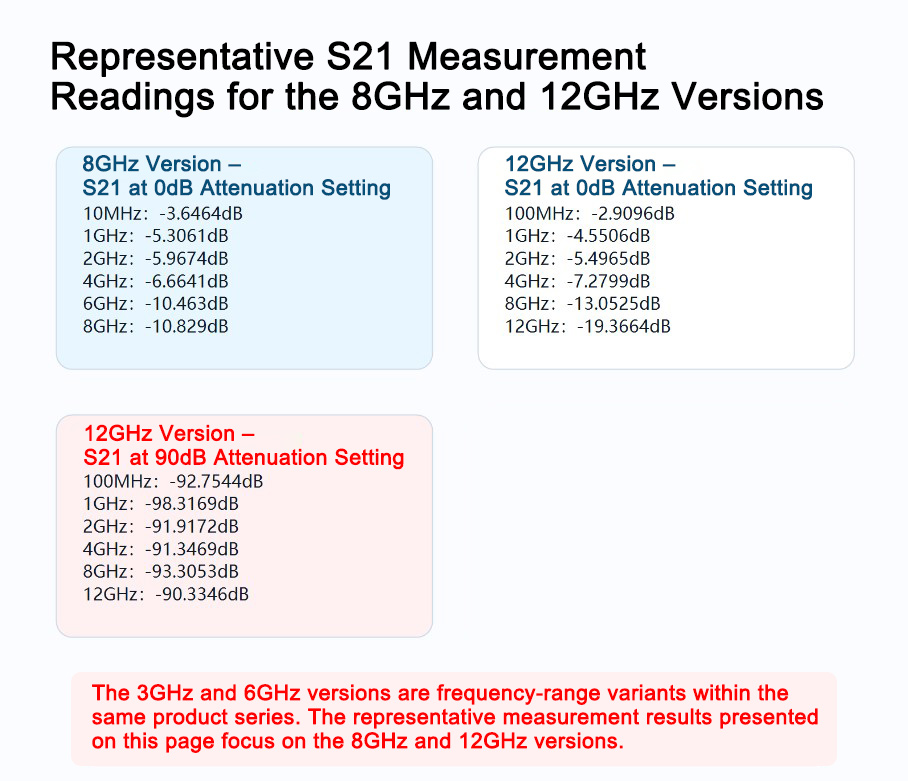
The 9K-3G/6G/8G/12G 90dB Digital Programmable Attenuator is a high-frequency digitally controlled attenuator module designed for precise signal amplitude adjustment. It features accurate attenuation control, low insertion loss, and high isolation, making it suitable for sensitivity measurements, channel attenuation simulation, and automated RF ATE testing. Available in four frequency range versions to meet different testing requirements. Clear, measured S-parameter data is available for the 8G and 12G versions.
Features:
Digital Programmable Control & Precise Attenuation Adjustment
* Digital Programmable Control: Attenuation values can be controlled through software programs or serial commands, making the module suitable for automated testing, batch sweep testing, and long-term stability verification.
* Precise Attenuation Adjustment: Features a fine attenuation step of 0.25dB, allowing gradual signal level adjustments to accurately identify receiver sensitivity thresholds.
* Fast Switching: Eliminates the need to manually replace fixed attenuator pads, ensuring a more continuous testing process and enabling rapid switching between multiple attenuation levels.
* Wide Attenuation Range: Provides a wide attenuation range of 0-90dB, covering standard signal adjustment, weak signal simulation, and high-attenuation isolation testing.
* Wide Range of Applications: Ideal for RF applications requiring repeatable, traceable, and automated signal amplitude control.
Low Insertion Loss, High Isolation & Wide-Temperature Stability
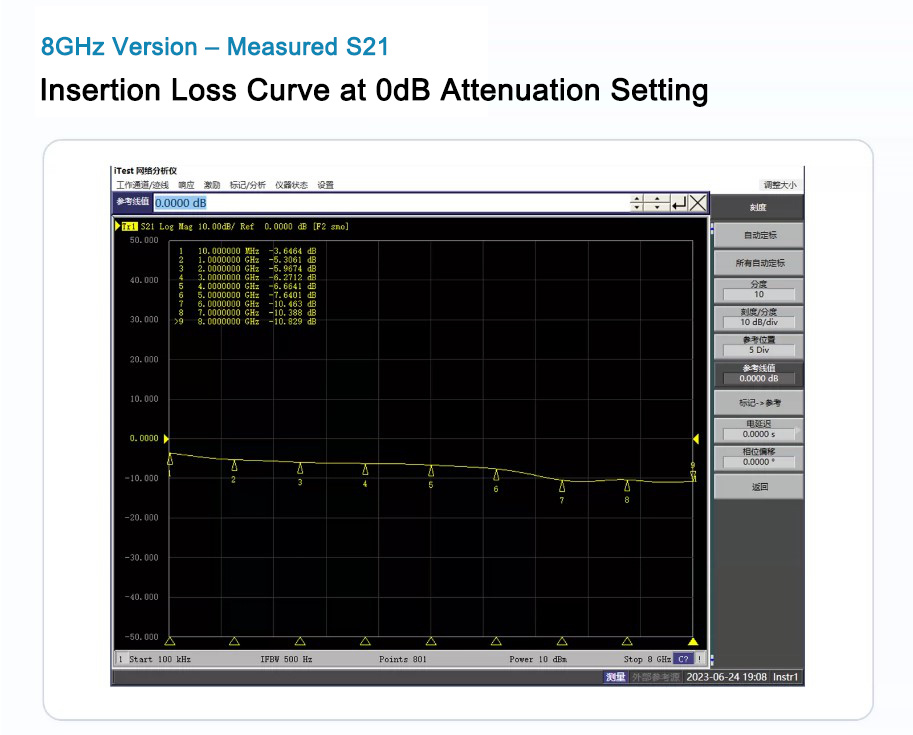
* Low Insertion Loss: The S21 insertion loss curve at the 0dB setting can be used to evaluate the signal transmission loss introduced by the module itself.
* High Isolation: The S21 performance at the -90dB setting demonstrates high attenuation capability, making it suitable for weak signal and isolation performance evaluation.
* Wide-Temperature Stability: Suitable for engineering tests and long-term operation. Specific operating temperature specifications can be confirmed according to project requirements.
* Flexible Design Options: Various solutions are available upon request, including GaAs/SOI chips, surface-mount chips, modular integrated units, and benchtop programmable attenuators.
Programmable Control for Automated Test Equipment
* TTL Serial Control: Can be integrated with microcontrollers, industrial PCs, and automated test systems, facilitating secondary development and system integration.
* USB Virtual COM Port: Connects to a computer and supports control through host computer software, making it convenient for laboratory testing and debugging.
* Custom SPI Interface: SPI interfaces, specific communication protocols, and synchronized multi-channel control can be customized according to project requirements.
* Automated Sweep Testing: Attenuation values can be adjusted step by step through scripts, with test results such as BER, PER, RSSI, and packet loss rate automatically recorded.
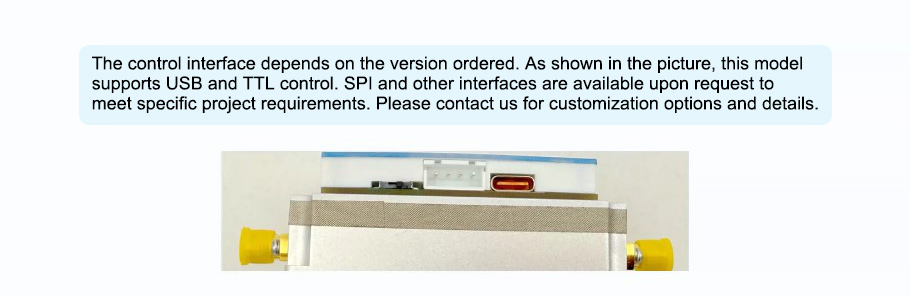
* Control Interface Notice: The actual control interface depends on the version ordered. As shown in the product images, this model supports USB/TTL control. SPI and other interfaces are available for customization according to project requirements. Please contact us for customization details.
Applications in Wireless Communications & RF Testing
* 5G Macro Base Stations & Small Cells: Suitable for link attenuation, receiver performance, and channel consistency testing. Customized solutions are available for Massive MIMO channel equalization.
* RF Automated Test Equipment (ATE): Ideal for automated test benches, production line sampling inspections, module consistency verification, and multi-level attenuation sweep testing.
* Satellite Ground Stations – Rain Fade Compensation: Simulates changes in link attenuation to evaluate system stability under different signal margin conditions.
* BeiDou/GPS Navigation Systems: Suitable for weak-signal reception testing, receiver sensitivity threshold verification, and signal strength simulation.
* Advanced RF Applications: Customized solutions are available for higher-frequency and multi-channel projects, including active phased-array radar beam-forming, 77GHz automotive millimeter-wave radar, and electronic warfare systems. Please contact us to discuss specific requirements.
Sensitivity Measurement & Channel Simulation
* Receiver Sensitivity Measurement: A signal generator outputs a signal at a known power level. The programmable attenuator gradually reduces the signal strength until the receiver reaches the threshold at which it can still meet the specified BER, PER, or packet loss rate requirements.
* Wireless Channel Simulation: Uses controlled attenuation to simulate increased transmission distance, signal obstruction, reduced link margin, and gradual signal fluctuations. This allows engineers to evaluate connection drops, reconnection behavior, and bit error performance.
* Massive MIMO & Multi-Channel Testing: Different attenuation levels can be configured for individual channels to support channel equalization, link consistency testing, and system margin verification. Customized multi-channel solutions are available upon request.
* Fine Attenuation Resolution: The 0.25dB step size enables precise threshold testing, while the wide 90dB attenuation range supports weak-signal simulation and high-attenuation isolation testing.
USB Virtual COM Port Control Instructions:
1. Communication Method
* Connect the module to a computer via the USB Type-C port. The module will be recognized as a USB Virtual COM Port (VCP). Attenuation values can then be controlled using the host computer software or a serial terminal tool.
2. Command Terminator
* All control commands must end with a carriage return and line feed (CRLF).
* When sending commands, make sure the serial terminal software is configured to append both carriage return and line feed.
3. Setting the Attenuation Value
* Command Format: att-xx.xx or att-xxx.xx
* Examples: att-10.00, att-35.25, att-90.00
* Attenuation values are adjustable in 0.25dB increments.
4. Module Response
* Successful Setting Response: attOK
* Read Current Status Command: READ
* USB communication operates through a Virtual COM Port, so the baud rate is generally not a critical parameter. Actual communication settings depend on driver and software recognition.
5. Applicable Scenarios
* USB control is suitable for PC-based host software, laboratory debugging, automated attenuation sweep testing, and production line RF ATE applications.
* Note: Communication protocols may vary between production batches or customized versions. Please refer to the documentation supplied with the product or contact customer support for the applicable protocol specifications.
TTL Serial Port Control Instructions:
1. Serial Communication Parameters
* Baud Rate: 9600bps
* Data Bits: 8
* Parity: None
* Stop Bits: 1
* If a customized communication protocol is used, please refer to the documentation supplied with the product.
2. Wiring Instructions
* GND: The controller and module must share a common ground.
* TXD/RXD: Connect the controller TXD to the module RXD, and the controller RXD to the module TXD.
* +5V Power Supply: Connect the power supply according to the pin labels on the module interface.
3. Attenuation Setting Commands
* Command Format: att-xx.xx or att-xxx.xx
* Examples: att-00.00, att-20.25, att-90.00
* Command Terminator: Append CRLF to the end of each command.
4. Response & Status Reading
* Successful Setting Response: attOK
* Read Current Status Command: READ
* TTL serial control is suitable for microcontrollers, industrial PCs, automated equipment, and embedded system integration. It enables standalone control without a computer, allowing attenuation values to be sent through predefined scripts from microcontrollers, PLCs, or industrial control systems.
5. Important Notes
* Pay attention to signal voltage levels, power supply requirements, and wiring polarity. For the initial connection, low-power testing is recommended to verify correct wiring and successful communication before normal operation.
Technical Specifications:
3G Version:
* Frequency Range: 9kHz-3GHz
* Attenuation Range: 0-90dB
* Attenuation Step: 0.25dB
6G Version:
* Frequency Range: 9kHz-6GHz
* Attenuation Range: 0-90dB
* Attenuation Step: 0.25dB
8G Version:
* Frequency Range: 9kHz-8GHz
* Attenuation Range: 0-90dB
* Measured S-Parameter Data: Available
12G Version:
* Frequency Range: 9kHz-12GHz
* Attenuation Range: 0-90dB
* Measured S-Parameter Data: Available
General Specifications:
* Power Supply: DC 5V via USB Type-C
* RF Connectors: SMA Female, 50Ω
* Maximum Input Power: 30dBm/1W
* Communication Interfaces: USB Virtual COM Port/TTL Serial Port
Important Notes:
* Please confirm the required frequency version (3G, 6G, 8G, or 12G) before placing your order.
* The product listing primarily features measured S-parameter data for the 8G and 12G versions.
* Four frequency range versions are currently available. Higher-frequency applications are not automatically covered by these versions and require a separately customized frequency-specific solution.
Packing List:
* 1 x Digital Programmable RF Attenuator
* 1 x USB Cable
Packaging Details:
* Package weight: 0.35kg