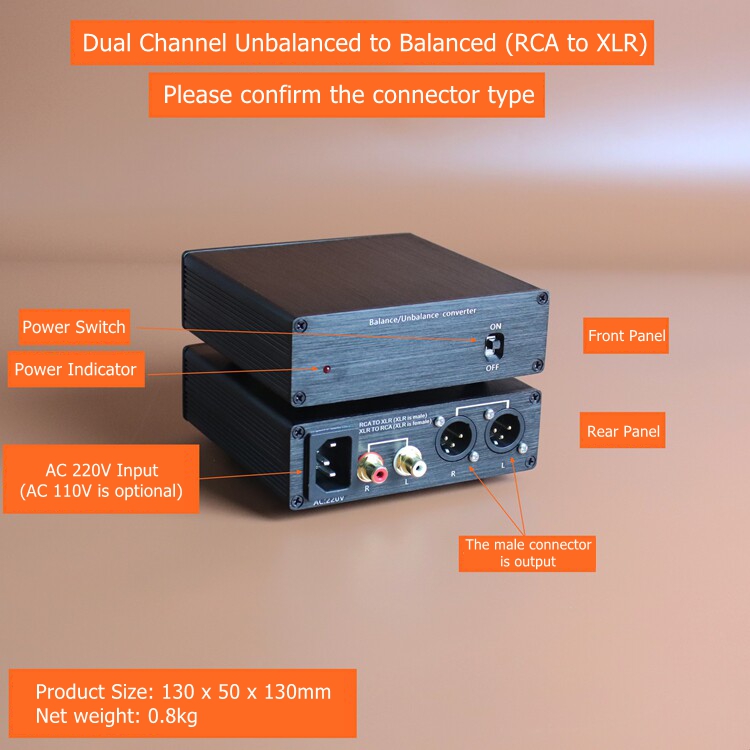
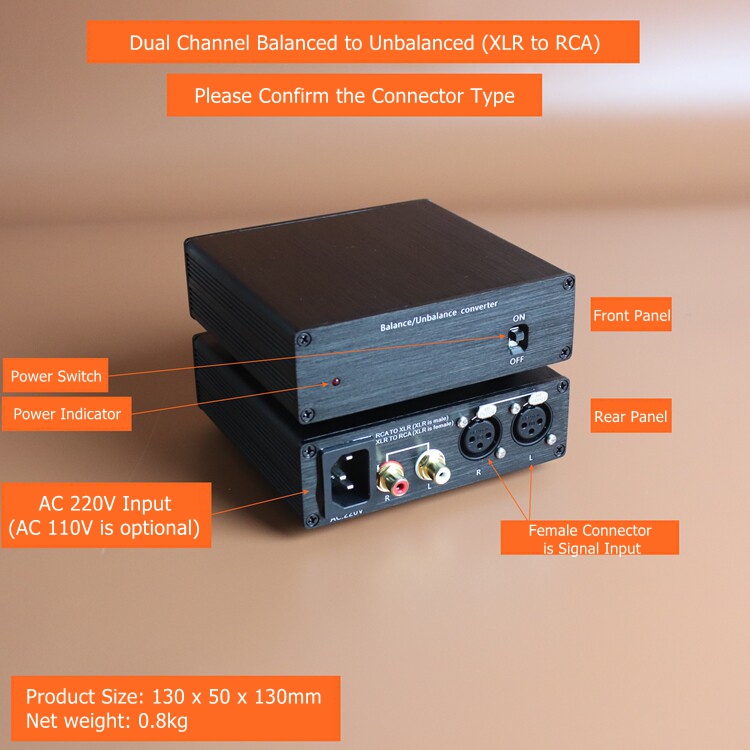
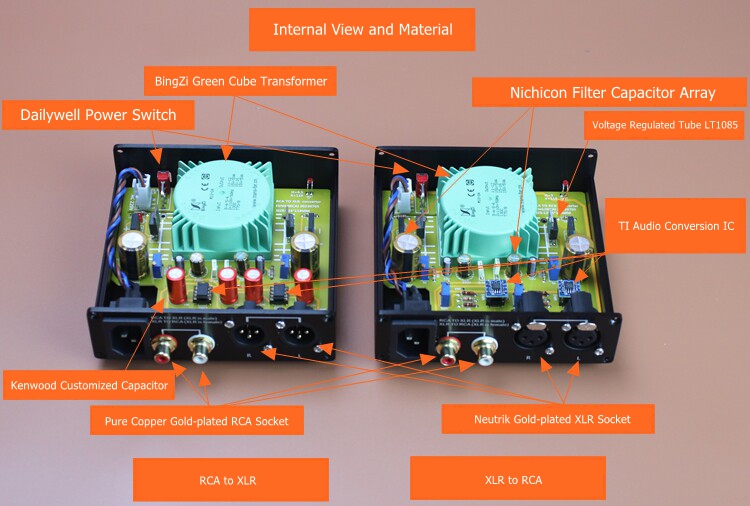
Dual Channel XLR to RCA / RCA to XLR Audio Converter Balanced to Unbalanced Signal Conversion Audio Switch Built-in Power Supply
Не удалось загрузить сведения о доступности самовывоза

Introduction:
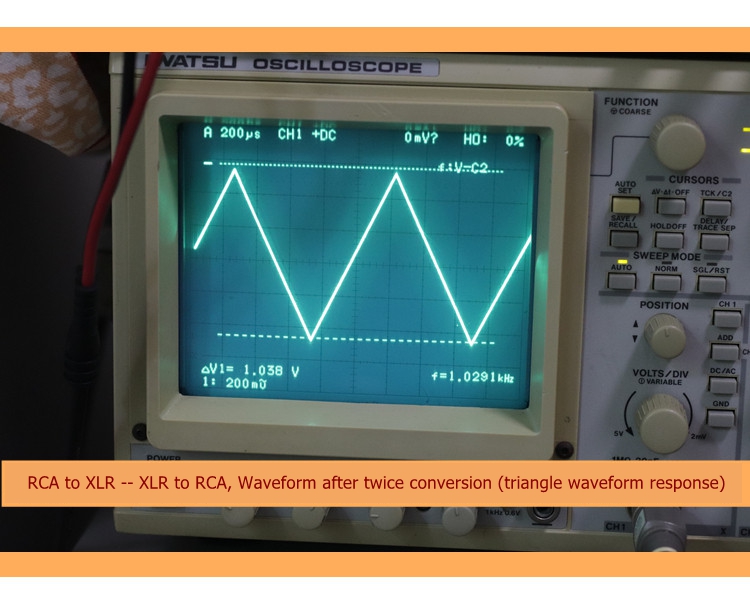
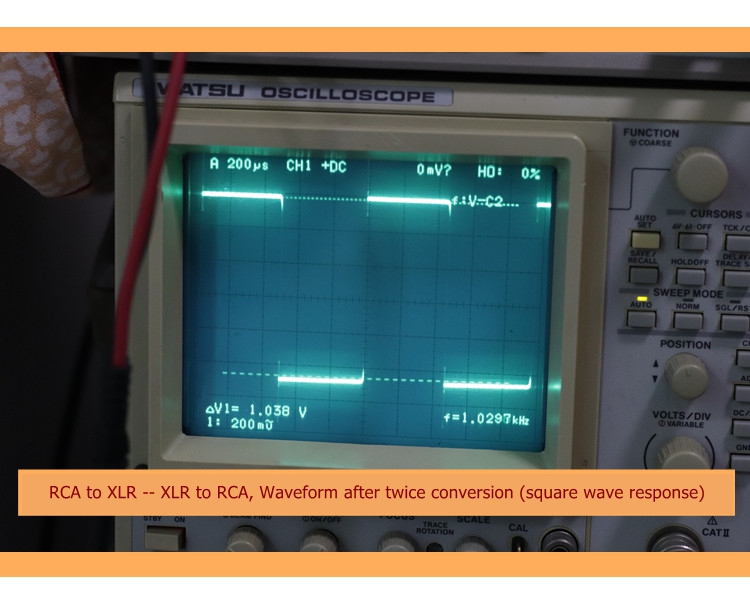
- There are two methods for balanced and single-ended conversion: passive conversion, using an audio transformer. The advantage is that it does not require electricity and is convenient, but the disadvantage is that the cost of an audio transformer that can meet HIFI transmission is expensive. Ordinary transformers have non-linear transmission for the entire frequency band of the audio range; The second method is active conversion, using operational amplifiers or discrete components (even electronic tubes), which has the disadvantage of poor symmetry in balanced signal regeneration or synthesized waveforms. The most ideal scenario is to use a dedicated conversion IC. Since an IC is used, it must belong to active conversion; This IC is similar to an operational amplifier, but the difference is that the internal resistance of the chip is laser engraved and precisely fine tuned, making the cold and hot end signals strictly symmetrical: Pay attention! This is the essence of balanced circuits: high common mode rejection ratio. The biggest advantage of high common mode rejection ratio is that the background is quiet and the restoration of weak signals is high. Non formal conversion methods: using conversion wires, grounding the cold end, etc. True balanced amplification circuits have independent amplification units for both cold and hot signals. If you ground the cold end circuit port, the true balanced XLR line ground wire (i.e. shielding layer) has no current flow and is purely shielded; Once the balanced signal is unbalanced or false balanced, signal current will flow through the ground wire, which is bad. It is likely to mix noise current and form interference.
- Converter gain (commonly known as amplification factor): 1, without amplification effect, and peripheral circuits cannot be set. For example, when convert RCA to XLR, the input signal level of RCA is 1V, and after conversion, it outputs positive phase 1V and negative phase 1V from pins 2 and 3 of the XLR. The principle of balanced driving is push-pull, so the level reflecting the sound size is the level between the positive and negative phases, which is 2V. If the balance continues, the level doubles, but it cannot be said that the converter has an amplifying effect; When converter XLR to RCA, assuming the balanced level is 1V in the positive phase and 1V in the negative phase, converts to RCA with an output level of 2V. This means that the original balanced cold and hot end signals are superimposed, and should not be understood as an amplification factor of 2. The levels mentioned here are all ground levels. Active converter, built-in power supply, directly plugged into AC 220V.
Package Included:
- 1 x Audio Converter